

Somewhere in Montgomery County right now, a baby is taking her first breath.
Maybe she was born at Lankenau Medical Center to parents who spent months preparing her nursery. Maybe he arrived at Einstein Medical Center Montgomery to a mother who missed two prenatal appointments because no evening clinic hours were available. Maybe she came into the world in a Lansdale bedroom attended by a midwife, while her father paced the hallway practicing the English words he would need to call the pediatrician on Monday.
Six zip codes. Six sets of circumstances. Six futures that will be shaped less by who these children are than by where they are—by the ecosystem of support, risk, and opportunity that surrounds their first 1,000 days of life.
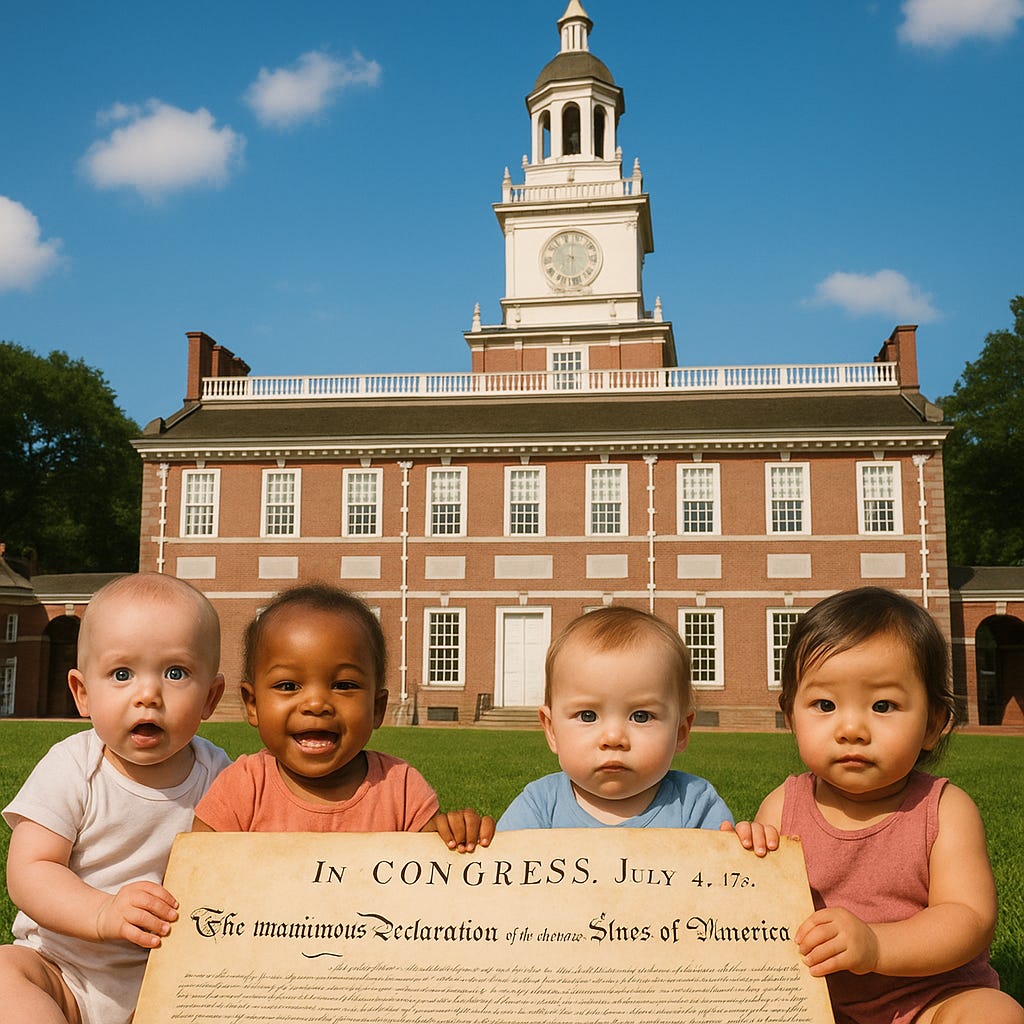
We know their names. We have been building their stories. Grace in Lower Merion. Jaylen in Norristown. Sofia in Lansdale. Aiden in Pottstown. Amara in Cheltenham. Riley in Abington. They are composites—AI-generated portraits drawn from real demographic data, community health assessments, and the lived realities of families across our county. None is a single real child. All are real in the ways that matter.
And all of them pose the same question to the rest of us:
What do we owe them?
This article is an invitation. Not to receive an answer, but to help build one—through an ongoing, structured, citizen-led deliberation that sits at the heart of the Montco PA First 1,000 Days of Life Initiative.
The Question Beneath the Question
“What do we owe our newborns?” sounds like it should have a simple answer. Feed them. Keep them safe. Love them. And of course, all of that is true—but it is not nearly enough.
The question goes deeper, into territory that is simultaneously philosophical, biological, political, and profoundly practical. It asks us to confront what kind of community we are, what kind of community we want to become, and whether we are willing to organize ourselves around the well-being of those who cannot yet speak for themselves.
Consider: during the first 1,000 days—from conception through a child’s second birthday—the brain forms 700 to 1,000 new neural connections every second. Foundations are laid for cognitive ability, emotional regulation, language, social skills, and the capacity to manage stress. Secure attachment forms, or doesn’t, based on whether caregiving is responsive and reliable. Epigenetic changes occur that can shape health across an entire lifespan.
What happens in this window is not easily reversed later. A child who experiences chronic stress, inadequate nutrition, or impoverished linguistic stimulation in the first 1,000 days faces developmental headwinds that no amount of intervention at age ten or eighteen can fully overcome.
This is not speculation. It is the settled science of early childhood development, confirmed by decades of longitudinal research. Every dollar invested in the first 1,000 days yields a return of $7 to $13 over a person’s lifetime—not because early childhood is sentimental, but because it is foundational.
And yet, when we look honestly at Montgomery County—one of the wealthiest counties in Pennsylvania, home to world-class medical institutions and excellent schools—we find that what a child receives in these critical days depends overwhelmingly on which zip code appears on her birth certificate.
Grace, in Lower Merion, will receive the full ecosystem: comprehensive prenatal care, paid parental leave, a pediatrician ten minutes away, a neighborhood saturated with resources. Jaylen, fourteen miles north in Norristown, will encounter friction at every turn—scheduling barriers, insurance navigation, food access gaps—not because his parents are less committed, but because the systems around them are less forgiving. Sofia, in Lansdale, will bring extraordinary family strengths that our institutions are poorly designed to recognize or support. Aiden, in Pottstown, will grow up in a community where the same service that is a ten-minute drive in Lower Merion may be forty-five minutes away. Amara, in Cheltenham, will face the statistical shadow of structural racism that persists regardless of her parents’ education or income. And Riley, in Abington, will navigate the first 1,000 days with a single mother who is competent, motivated, and drowning in logistics because every system she encounters was designed for two-parent households.
Six children. One county. A gulf of inequality that widens with terrible efficiency over 1,000 days unless something intervenes.
That “something” is what this Initiative—and this deliberation—is designed to be.
Beyond Survival: The Capabilities We Owe
The philosopher Martha Nussbaum, building on Amartya Sen’s work, argues that what we owe people is not merely resources—but the capability to convert resources into genuine functioning. Having money means nothing if you lack health. Having health means nothing if you lack education. Having education means nothing if the community around you offers no opportunity to use it.
This insight transforms how we think about our obligation to Montco’s newborns.
We do not owe them only safety and sustenance. We owe them capability—the genuine ability to develop, learn, connect, and eventually participate as full members of a democratic community. The capabilities approach asks us to think about the conditions required for a truly flourishing life, and to take seriously the idea that those conditions must be available to every child, not just those whose families can afford to purchase them privately.
What does capability look like in the first 1,000 days? It looks like a mother who has access to prenatal care regardless of her insurance status. It looks like a father who can take leave from work to be present for his child’s earliest weeks without risking the family’s financial stability. It looks like a pediatrician who is close enough and culturally attuned enough that well-child visits actually happen on schedule. It looks like nutrition security, safe housing, mental health support for overwhelmed parents, and early intervention services that reach families before small delays become large ones.
It looks, in other words, like what Grace already receives—extended, as a matter of community commitment, to every child in the county.
This is the moral core of the First 1,000 Days Initiative. Not charity. Not pity. Justice. The recognition that every child born in Montgomery County is created equal in dignity and worth, and that our systems should reflect that equality rather than contradict it.
The Salutogenic Turn: Asking a Different Question
Traditional public health asks: What makes people sick? The First 1,000 Days Initiative asks a different question, drawn from the salutogenic paradigm developed by Aaron Antonovsky: What creates health?
This is not a semantic distinction. It represents a fundamental shift in how we approach the well-being of families and children. Rather than cataloging deficits, risk factors, and pathologies, salutogenesis directs our attention to the resources, relationships, and conditions that enable people to move toward health and flourishing—even in the face of adversity.
When we look at Sofia’s family through a pathogenic lens, we see language barriers, institutional wariness, and gaps in service access. When we look through a salutogenic lens, we see deep family cohesion, powerful intergenerational care traditions, a faith community that functions as a safety net, and a work ethic that sustains the family through extraordinary pressures. The question is not “What is wrong with this family?” but “What strengths does this family possess, and how do we build systems that recognize and amplify them?”
When we look at Amara’s family salutogenically, we see parents with education, intentionality, strong social bonds, and the cultural knowledge to provide the nurturing environment their daughter needs. The question becomes: What structural conditions—systemic racism, fragile informal childcare arrangements, tax base limitations in border communities—threaten to undermine what this family is already doing right?
This shift from pathogenesis to salutogenesis runs through every dimension of the Initiative. It shapes how the People’s Commission frames its inquiries, how our AI tools are designed, how interventions are developed, and how we measure progress. We are not asking what is broken in Montgomery County. We are asking what it takes to build a county where every child can flourish—and then organizing ourselves to build it.
The Architecture: How the Initiative Works
Understanding the Initiative requires seeing how its parts fit together. The structure operates at three levels, each reinforcing the others.
Level 1: The National Framework
At the highest level sits the Democracy, Opportunity and Citizenship (DOC) Moonshot—a national framework aimed at providing every American with the core capabilities needed to live healthy, flourishing lives and engage as active citizens. The DOC framework rests on three pillars: strengthening democratic participation, ensuring equitable opportunity, and cultivating the capacities of citizenship from the earliest days of life.
Level 2: The Cornerstone Initiative
Within the DOC Moonshot, the First 1,000 Days of Life Initiative serves as the foundational cornerstone—grounded in the conviction that democratic vitality begins with the well-being of our youngest members. Montgomery County serves as the living laboratory: a pilot site where the Initiative’s ideas are tested, refined, and proven before being offered as a replicable model for communities across the country.
Level 3: Seven Integrated Components
The Initiative operates through seven components that function not as independent programs but as a reinforcing system. Each component feeds into and draws from the others:
1. Comprehensive Research and Evidence Base. Everything begins with understanding. The Initiative is building a deep, evidence-based picture of what children and families in Montgomery County need to thrive—reviewing the scientific literature, identifying gaps in the continuum of care, and generating the data that informs every other component.
2. The People’s Commission to Make Our Children Healthy. The citizen-driven body at the heart of the Initiative’s democratic architecture. The Commission puts the power of inquiry and recommendation directly into the hands of Montgomery County residents—parents, healthcare providers, educators, social workers, business owners, and community leaders who examine the ecosystem surrounding each child and develop recommendations grounded in both evidence and lived experience.
3. The Six Newborns Framework. Grace, Jaylen, Sofia, Aiden, Amara, and Riley serve as the narrative and diagnostic engine connecting research to reality. Each newborn’s story maps onto the Initiative’s salutogenic ecosystem and reveals a different dimension of the challenge: Grace reveals the benchmark. Jaylen reveals the friction. Sofia reveals the cultural gap. Aiden reveals the geographic gap. Amara reveals the structural gap. Riley reveals the design gap.
4. AI-Powered Tools. Two complementary platforms—the Whole Person Salutogenic Assistant and My Healthy Montco PA—are being designed to put personalized, actionable support directly into the hands of families and service providers, responsive to the specific circumstances each newborn represents.
5. Culturally Relevant and Equitable Interventions. Shaped by what Sofia’s and Amara’s stories teach us about the limits of one-size-fits-all approaches, these programs are tailored to the specific needs and cultural contexts of different populations, with an unflinching focus on dismantling the structural barriers that produce health inequities.
6. The Supportive Ecosystem. The cross-sector infrastructure—healthcare professionals, educators, social service providers, faith communities, businesses, and policymakers working in coordination—needed to ensure that Grace’s starting advantages become everyone’s floor, not just her family’s ceiling.
7. Moonshot Press. The Initiative’s media platform and community engagement engine, making the work visible, participatory, and accountable through storytelling, citizen journalism, research translation, and structured public dialogue.
How the Components Connect
These seven components form a reinforcing cycle. Research generates the evidence. The People’s Commission ensures that community voice shapes how that evidence is interpreted. The Six Newborns ground abstract findings in human reality. AI tools translate research and community input into personalized guidance. Equitable interventions ensure that guidance reaches those who need it most. The supportive ecosystem provides the institutional infrastructure that makes sustained support possible. And Moonshot Press ties it all together through transparency, engagement, and accountability—creating a feedback loop between the community and every other component.
The newborns are the connective thread running through all of them. Every research finding, every policy recommendation, every technological tool, and every community conversation stays anchored in the irreducible reality of children’s lives.
From Framework to Action: An Engagement Strategy
A framework without action is an essay. The First 1,000 Days Initiative is designed to move from understanding to engagement to measurable change. Here is how the deliberation is structured—and how you can participate.
Phase 1: Foundation (Now through Spring 2026)
This is where we are. The foundational work involves building the knowledge base, publishing the research, introducing the six newborns, and preparing the People’s Commission for launch. During this phase, we are asking Montgomery County to do three things:
Learn. Follow the Thrive in Montco PA Substack. In the coming weeks, we will publish deep profiles of each newborn, tracing their first 1,000 days through the lens of the salutogenic ecosystem. We will share research briefs connecting each child’s circumstances to the evidence on what interventions make the greatest difference. We will introduce the AI tools being developed and explain how they work. The goal is to build a shared understanding—across the county—of what is at stake and what is possible.
Reflect. As you encounter each newborn’s story, ask yourself: Does this resonate with my experience? What resources exist in my community that families like these might not know about? What is missing? Where do the systems designed to support families break down? Your answers matter—not as abstract opinions, but as the lived knowledge that will shape the Commission’s work.
Connect. If you are part of an organization—a healthcare practice, a school, a social service agency, a faith community, a local business—begin considering how your work intersects with the first 1,000 days. The supportive ecosystem depends on cross-sector collaboration. No single institution can address this alone.
Phase 2: Investigation and Design (Spring–Summer 2026)
The People’s Commission launches. Using the six newborns as its central organizing framework, the Commission will conduct structured inquiries into the ecosystem surrounding each child. Commission members will hear testimony from families, providers, researchers, and community leaders. They will examine what resources are present, what is missing, and where county systems fail to deliver on their stated purpose.
Your role in this phase: Participate. Attend community listening sessions—online and in-person—where your firsthand experience informs the Commission’s understanding. Volunteer for the grassroots data crowdsourcing effort that will map available local resources in real time, identifying service deserts and surfacing solutions that may be invisible to policymakers. Engage with the citizen briefs that Moonshot Press will publish to translate complex findings into accessible, actionable formats.
Phase 3: Deliberation and Recommendations (Fall 2026–Winter 2027)
The Commission synthesizes what it has learned and develops concrete, community-specific policy recommendations. These are not top-down mandates. They are proposals developed by the people closest to the challenges, grounded in evidence and shaped by the democratic process of structured deliberation.
Your role in this phase: Respond. Review the Commission’s emerging recommendations. Challenge them. Strengthen them. Share them with your networks. The collaborative policy workshops during this phase will bring together diverse stakeholders to co-draft proposals that serve as adaptable templates—designed not only for Montgomery County but as models other communities can modify and implement.
Phase 4: Accountability and Scaling (2027 and Beyond)
Recommendations become action. The Initiative tracks implementation, measures outcomes against the six newborns’ trajectories, and reports publicly on what is working and what is not. The monitoring framework uses the newborns as longitudinal case studies—a living dashboard that asks, at every stage, whether what we are doing is making a difference for the children who need it most.
Your role in this phase: Hold us accountable. The entire architecture of the Initiative—the open-source knowledge platform, the public reporting, the community engagement channels—is designed to make the work transparent. If recommendations are not being implemented, say so. If outcomes are not improving, demand to know why. Citizen oversight is not a courtesy; it is a structural feature of the design.
Five Dimensions of Obligation: A Framework for Deliberation
To give structure to the deliberation, the Initiative organizes the question “What do we owe the Montco newborns?” across five interconnected dimensions. These are not separate conversations. They are lenses through which the same fundamental obligation can be examined, debated, and translated into action.
The Philosophical Dimension. What does it mean to say that every child is created equal in dignity and worth? What obligations flow from the recognition that newborns cannot advocate for themselves? How do the capabilities approach, the concept of natality, and the principles of justice apply to the specific circumstances of Montgomery County’s children?
The Political Dimension. What is the role of government—county, state, and federal—in securing the conditions for child flourishing? How should resources be allocated across a county where median household income varies from $45,000 to over $130,000 by municipality? What policies—paid family leave, expanded Medicaid, universal Pre-K, environmental protections—would make the greatest difference in closing the gaps between Grace and Jaylen, between Amara and Aiden?
The Biological Dimension. What does developmental science tell us about the non-negotiable requirements of the first 1,000 days? Where are the critical intervention points—prenatal nutrition, responsive caregiving, toxic stress reduction, developmental screening—where action has the highest leverage? How do environmental factors like lead exposure, air quality, and food access interact with biological development?
The Social Dimension. What roles do relationships, community, and culture play in creating the conditions for health? How do we build systems that recognize and amplify the strengths families already possess—Sofia’s intergenerational care traditions, Amara’s extended family networks, Jaylen’s parents’ deep commitment—rather than treating culturally different approaches as deficits?
The Spiritual and Ethical Dimension. What does it mean to value the preciousness of each life from its earliest moments? How do traditions of care, obligation, and repair—from Tikkun Olam to Catholic social teaching to the secular ethics of human dignity—inform our understanding of what we owe the most vulnerable among us?
The People’s Commission will take up each dimension in turn, using the six newborns as anchor points. The goal is not consensus on a single philosophical framework but shared commitment to concrete action that reflects the best of what we know and the fullness of what we owe.
What You Can Do Now
The deliberation begins with you. Here are the immediate ways to engage:
Subscribe to Thrive in Montco PA. Every installment builds on the last. In the coming weeks, you will meet each of the six newborns in depth, learn about the People’s Commission’s structure and mandate, and encounter the research that grounds the Initiative’s work. Subscribing ensures you are part of the conversation as it unfolds.
Share your voice. If you are a family navigating the first 1,000 days, a professional working with young children, or a community member with insights to share, your perspective is essential. Watch for opportunities to participate in listening sessions, contribute to resource mapping, and provide input to the Commission.
Connect your work. If your organization touches the lives of families and children—directly or indirectly—consider how your efforts align with the Initiative. The supportive ecosystem we are building depends on coordination across sectors that too often operate in isolation.
Advocate. Policy change is essential. Use the citizen briefs and research summaries the Initiative produces to advocate for policies that support families at the local, county, and state levels. When elected officials make decisions about health department budgets, childcare subsidies, environmental regulations, or school funding, the 2,300 babies born in Montgomery County each year are stakeholders who cannot speak for themselves. You can speak for them.
Spread the word. Talk about the first 1,000 days with your neighbors, colleagues, and representatives. The more people who understand why this window matters—and what Montgomery County is doing about it—the stronger the movement becomes.
A Closing Word
Six babies. Six sets of parents doing their best. Six zip codes that, within a single county, produce dramatically different starting conditions for life.
The salutogenic question is not what is wrong with the families whose children face the steepest odds. It is what conditions create health—and how we build those conditions everywhere.
The question “What do we owe the Montco newborns?” is not rhetorical. It is an invitation to a structured, sustained, citizen-led inquiry that will shape the future of this county. The People’s Commission is being assembled. The research is underway. The tools are being built. And now, with six stories and a framework for deliberation, the conversation has a face—six faces—and a question that belongs to all of us.
We did not choose these children’s circumstances. But we choose, every day, the systems that will shape their lives. Those choices carry obligations. And this Initiative exists to help us meet them.
What do we owe them? Come help us find out.
The Montco PA First 1,000 Days of Life Initiative is a project of the Institute for Salutogenesis and a cornerstone of the Democracy, Opportunity and Citizenship Moonshot. Follow Thrive in Montco PA for ongoing coverage, deep dives into each newborn’s story, and opportunities to participate in the People’s Commission.
Subscribe. Share. Show up. Every step we take today makes a world of difference for every child’s tomorrow.