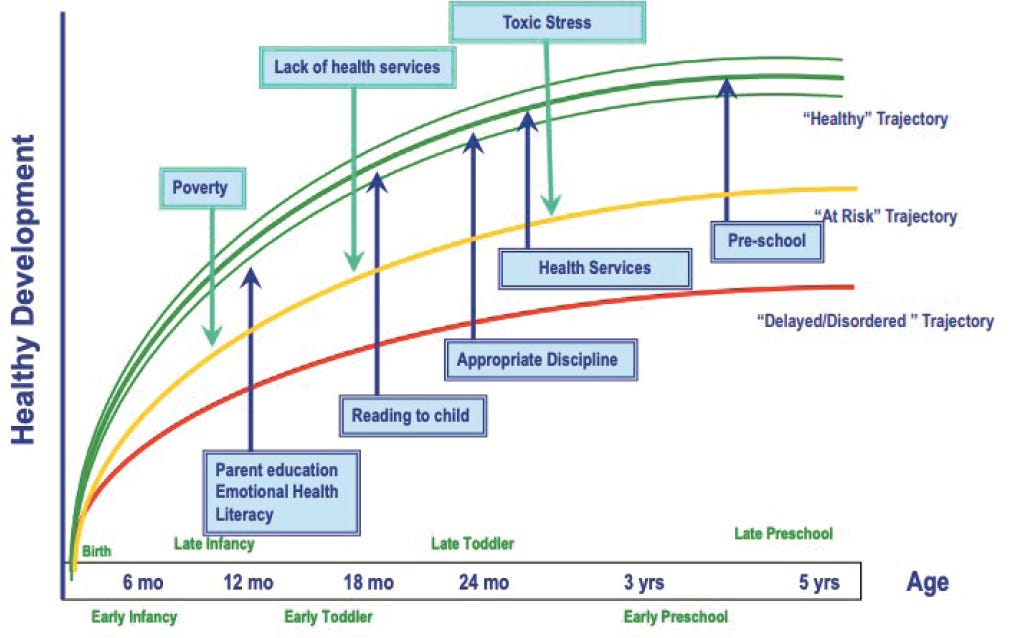
It is 6:47 a.m. on a Tuesday in Montgomery County, Pennsylvania. In a delivery room at Lankenau Medical Center, a mother holds her daughter for the first time. Fourteen miles north, at Einstein Medical Center Montgomery, a father counts ten tiny fingers through tears he didn’t expect. Across the county, in hospitals and birthing centers and, in one case, a bedroom where the ambulance didn’t arrive in time, six babies have entered the world in the past thirty-six hours.
They have never met. They never will, most likely. But from this moment forward, their lives will unfold along trajectories shaped less by who they are than by where they are—by the zip code printed on their birth certificate, the resources available within a few miles of their crib, and the systems that either catch their family or let them fall.
This is the story of six newborns in Montgomery County. They are composites—AI-generated representative portraits drawn from real demographic data, community health assessments, and the lived realities of families across our county. None of them is a single real child. All of them are real in the ways that matter: in the challenges they face, the opportunities they may or may not receive, and the question their existence poses to the rest of us.
What do we owe them?
Why We Built These Portraits
The Montco PA First 1,000 Days of Life Initiative, a cornerstone of the Institute for Salutogenesis’s Democracy, Opportunity and Citizenship Moonshot, is built on a conviction: that the period from conception through a child’s second birthday is the most consequential window in human development, and that what a community provides during this window reveals its deepest values.
But statistics alone don’t move people. Knowing that Montgomery County’s infant mortality rate varies by neighborhood, or that developmental screening rates differ dramatically by zip code, is important. It is not, by itself, enough.
We need to see the children.
The six newborns you are about to meet are not case studies. They are narrative instruments—carefully constructed composites that translate population-level data into human-scale stories. Each one represents a real cluster of circumstances that families in Montgomery County navigate every day. By following these children through their first 1,000 days, we can trace how biological potential interacts with social reality, how policy decisions land in living rooms, and where the gaps in our systems become chasms that swallow futures.
They will serve as the shared reference points for the Initiative’s work: grounding our research, shaping the People’s Commission’s inquiries, informing our AI tools, and anchoring the community conversations that Moonshot Press will host in the months ahead.
Meet them now. We will be spending a long time together.
The Six Newborns of Montco PA
1. Grace — Born in Lower Merion (19003)
Grace arrives on a crisp January morning at Lankenau Medical Center, weighing seven pounds, four ounces. Her parents, a biotech researcher and a corporate attorney, have been preparing for her arrival with the thoroughness their professional lives trained them for. Her nursery is ready. Her pediatrician was selected months ago. Her mother’s employer provides sixteen weeks of paid parental leave; her father’s provides twelve.
Grace’s family lives in a neighborhood where the median household income exceeds $130,000. The local school district is among the highest-rated in Pennsylvania. A farmers’ market operates within walking distance. Three pediatric practices are within a ten-minute drive. Her parents’ social network includes other new parents, lactation consultants they found through their hospital’s concierge service, and grandparents who live close enough to help.
What Grace’s story reveals: Grace represents the children for whom Montgomery County’s systems work almost seamlessly. She will likely hit every developmental milestone on schedule, receive every recommended screening, and enter kindergarten with a vocabulary built on thousands of hours of responsive interaction. Her story is not one of challenge but of benchmark—she illustrates what is possible when the full ecosystem of support is in place. The question she raises for the Initiative is not what to do for Grace, but how to make what Grace receives available to every child in the county. Grace also shows us that even in affluent communities, isolation, postpartum mental health challenges, and the pressures of high-achievement culture can create invisible vulnerabilities that a truly salutogenic approach must address.
2. Jaylen — Born in Norristown (19401)
Jaylen is born at Einstein Medical Center Montgomery to Destiny, twenty-three, who works as a certified nursing assistant at a rehabilitation facility. His father, Marcus, drives for a rideshare company while studying for his commercial driver’s license. They are not married but committed to co-parenting. They live in a rented two-bedroom apartment near Main Street.
Destiny’s pregnancy was complicated by gestational diabetes, diagnosed late because she missed two prenatal appointments—her work schedule made daytime visits nearly impossible, and the clinic’s evening hours were limited. She had Medicaid coverage, which will extend postpartum, but navigating the system to find a pediatrician accepting new Medicaid patients took three weeks of phone calls.
Norristown, the county seat, is one of Montgomery County’s most economically diverse communities. The median household income is roughly $45,000—a third of Lower Merion’s. Food access is uneven; the nearest full-service grocery store is a bus ride away. The school district has been working to close achievement gaps but faces persistent funding challenges compared to surrounding districts.
What Jaylen’s story reveals: Jaylen’s family is not in crisis. They are working, planning, and deeply invested in their son’s future. But the friction they encounter at every turn—scheduling barriers, insurance navigation, food access, childcare costs that will consume nearly half of Destiny’s take-home pay—creates a cumulative drag on the very responsive caregiving and low-stress environment that early development requires. Jaylen’s story is the story of the near-miss: the family that almost gets what it needs, almost reaches every resource, but finds that “almost” compounds over 1,000 days into measurable developmental gaps. For the Initiative, Jaylen represents the power of removing friction—of building systems smooth enough that committed parents can actually access the support that exists.
3. Sofia — Born in Lansdale (19446)
Sofia is born at home, attended by a midwife, to parents who emigrated from Guatemala six years ago. Her mother, Lucia, cleans houses; her father, Carlos, works in commercial landscaping. They speak Spanish at home. Lucia’s English is conversational but not yet confident enough for medical terminology, and Carlos’s is limited. They have two older children, ages four and two.
Sofia’s parents are documented residents with work permits, but they remain cautious around government systems. Lucia received prenatal care through a community health center where a bilingual nurse practitioner made her feel welcome—one of the few providers in the area offering services in Spanish. The family attends a Catholic parish in Lansdale that provides informal support networks and occasional food assistance.
Lansdale and the surrounding North Penn area have experienced significant demographic shifts in recent years, with a growing Latino population that the service infrastructure has not fully caught up to. WIC enrollment among eligible Latino families in the area is lower than the county average, not because families don’t qualify but because outreach materials and enrollment processes have been slow to adapt.
What Sofia’s story reveals: Sofia’s parents possess extraordinary generalized resistance resources that standard assessments often miss: deep family cohesion, strong community ties through their parish, a powerful work ethic, and cultural traditions that prioritize intergenerational care. The salutogenic framework sees these as genuine assets—sources of meaning, manageability, and coherence. But language barriers, cultural unfamiliarity with American health systems, and an institutional environment that was built for English-speaking families create gaps that can widen over 1,000 days. Sofia’s story challenges the Initiative to design systems that recognize and build on existing strengths rather than treating culturally different families as deficient. She also highlights the critical role that trusted community institutions—churches, cultural organizations, informal networks—play in the ecosystem of early childhood support.
4. Aiden — Born in Pottstown (19464)
Aiden is born at Pottstown Hospital to parents who are both from families that have lived in the Pottstown area for generations. His mother, Kristen, twenty-seven, worked as a warehouse associate until her eighth month of pregnancy. His father, Ryan, is a welder at a small fabrication shop. They own a modest row home purchased with help from Ryan’s parents.
On paper, Aiden’s family is stable. But the details tell a more complex story. Ryan’s shop does not offer health insurance; the family is covered through Kristen’s former employer under COBRA, which costs $1,400 a month and will expire in three months. Kristen has a history of anxiety that intensified during pregnancy but went untreated because the nearest therapist accepting their insurance had a two-month wait. Ryan’s mother, who was going to help with childcare, is managing her own chronic health issues.
Pottstown, in the western reaches of Montgomery County, is a post-industrial borough that has been working to reinvent itself. Poverty rates are higher here than in most of the county. The opioid crisis has left its mark on the community, straining social services and creating a generation of grandparents raising grandchildren. Access to mental health services, substance use treatment, and affordable childcare is limited relative to the eastern and southern parts of the county.
What Aiden’s story reveals: Aiden’s family defies easy categorization. They are not poor enough to qualify for many assistance programs, not prosperous enough to absorb the costs of a new baby without strain. They are the families that policymakers sometimes call “the gap population”—too much income for Medicaid, too little for the private safety net that affluent families take for granted. Aiden’s story reveals how geographic isolation within the county compounds economic vulnerability: the same service that is a ten-minute drive in Lower Merion may be forty-five minutes away in Pottstown, if it exists at all. For the Initiative, Aiden represents the importance of reaching beyond the county’s population centers and ensuring that western Montgomery County is not an afterthought.
5. Amara — Born in Cheltenham (19012)
Amara is born at Abington-Jefferson Health to her mother, Chioma, a first-generation Nigerian-American who works as a medical billing specialist, and her father, Terrence, a Philadelphia public school teacher. They chose to live in Cheltenham because it offered a diverse community close to Chioma’s extended family in the city—aunties and cousins who form the backbone of their childcare strategy.
Chioma had an uncomplicated pregnancy with consistent prenatal care. She plans to breastfeed and has the knowledge and family support to do so. Terrence has twelve weeks of leave under his union contract. On many measures, Amara’s start looks solid.
But Cheltenham, for all its diversity and community strength, sits at a fault line. It borders Philadelphia, and its school district serves a population with a wider income range than its tax base can easily support. Chioma, as a Black woman, is statistically at higher risk for maternal complications regardless of her education or income—a disparity rooted not in individual behavior but in the cumulative physiological effects of navigating systemic racism. And the family’s childcare plan, built on extended family rather than formal programs, is resilient but fragile: one illness, one job change, one unexpected demand on an auntie’s time, and the whole structure shifts.
What Amara’s story reveals: Amara’s family embodies the strengths that the salutogenic paradigm is designed to recognize and amplify: deep social bonds, cultural knowledge, mutual aid, and parents with both education and intentionality. Her story pushes the Initiative to grapple with a harder truth—that even when families do everything right, structural racism and the precariousness of informal support systems can create vulnerabilities that individual effort alone cannot overcome. Amara’s story is also about what Cheltenham’s diversity offers: a community where cross-cultural solidarity is possible, where different traditions of child-rearing can enrich each other, and where the People’s Commission can draw on a remarkable range of lived experience.
6. Riley — Born in Abington (19001)
Riley is born to a single mother, Meghan, thirty-one, who works as an office manager at a dental practice in Willow Grove. Meghan and Riley’s father separated during the pregnancy. He is involved but inconsistently, and the co-parenting arrangement is still being negotiated. Meghan’s parents live in Bucks County, close enough to help on weekends but not during the workweek.
Meghan has employer-sponsored health insurance and took advantage of her company’s six-week maternity leave policy. She is already anxious about returning to work and finding infant care she can afford on a single income. Full-time daycare in the Abington area runs between $1,200 and $1,800 a month—a staggering figure for a household operating on one salary. She has been looking into home-based providers, but vetting quality without a reliable referral network is overwhelming.
Meghan is resourceful and organized, but she describes her experience as “drowning in logistics.” Every decision—pediatrician selection, breastfeeding support, sleep training, financial planning—falls on her alone, and the cognitive load of solo parenting in the first months is immense.
What Riley’s story reveals: Riley’s family is not defined by poverty or systemic exclusion but by the particular vulnerability of the single-parent household navigating the first 1,000 days without a partner to share the load. Meghan’s story is increasingly common across all income levels and demographics: a competent, motivated parent whose greatest barrier is not lack of knowledge or will but the sheer organizational and emotional weight of doing it alone within systems designed for two-parent households. For the Initiative, Riley highlights the need for practical infrastructure—accessible childcare referral systems, postpartum mental health support that does not require a half-day off work, and employer policies that recognize the reality of modern family structures.
Six Children, One County, One Question
These six newborns were born within days of each other, within the borders of a single county. They share the same sky, the same state laws, the same county government. They are, in the language of the Declaration of Independence, created equal.
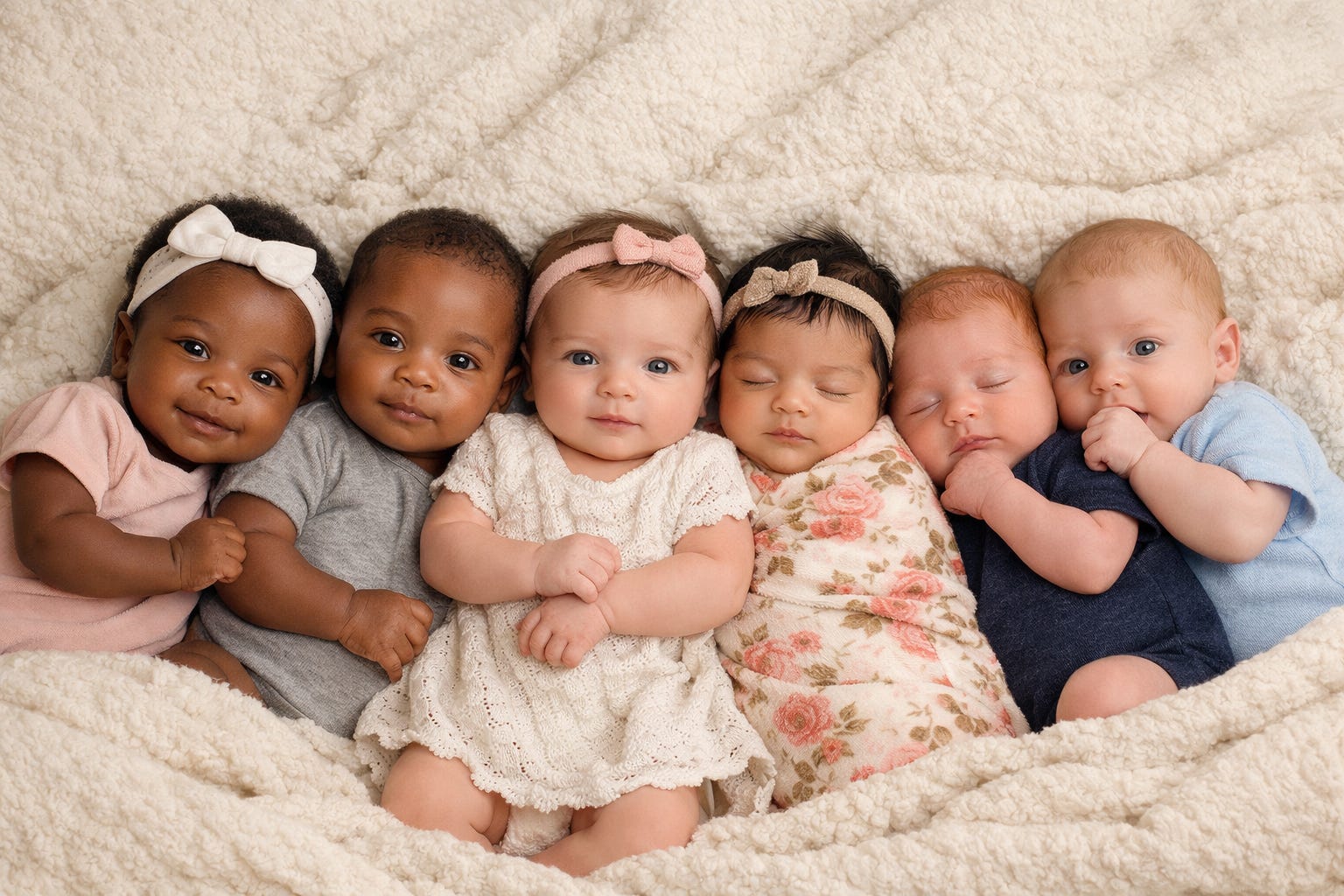
But they are not starting equal. And we know, from decades of developmental science, that the gaps visible at birth widen with terrible efficiency over the next 1,000 days—unless something intervenes.
That “something” is what this Initiative is designed to be.
How the People’s Commission Will Build on These Stories
The six newborns are not simply illustrations. They are working tools for the People’s Commission to Make Our Children Healthy—the citizen-driven body at the heart of the Initiative’s democratic architecture.
Here is how the Commission will use them:
Diagnostic Framework
Each newborn’s story maps onto the Initiative’s salutogenic ecosystem—the interconnected biological, psychological, social, environmental, healthcare, political, cultural, and commercial factors that shape a child’s trajectory. The Commission will use these six stories as diagnostic templates: examining what resources are present, what is missing, and where the systems designed to support families break down. Grace reveals the benchmark. Jaylen reveals the friction. Sofia reveals the cultural gap. Aiden reveals the geographic gap. Amara reveals the structural gap. Riley reveals the design gap.
Structured Deliberation
The People’s Commission will organize its inquiry around the question each newborn raises. Commission members—parents, healthcare providers, educators, social workers, business owners, and community leaders from across the county—will examine the ecosystem surrounding each child and develop recommendations grounded in both evidence and lived experience. These are not abstract policy exercises. They are attempts to answer, concretely, what it would take for each of these children to reach their second birthday with the foundation for a flourishing life.
Community Engagement
The newborns will anchor Moonshot Press’s community engagement strategy. As we publish deeper profiles of each child’s story in the coming weeks, we will invite Montgomery County residents to respond: Does this story resonate with your experience? What resources exist in your community that these families might not know about? What is missing? The six newborns become a shared language for a county-wide conversation about what we owe our youngest members.
Accountability and Measurement
As the Initiative develops its monitoring framework, the six newborns will serve as longitudinal case studies. We will track—through their composite profiles—how policy changes, new programs, and community initiatives would affect each child’s trajectory. They become a living dashboard: a way to ask, at every stage, whether what we are doing is making a difference for the children who need it most.
Connecting Local Stories to National Stakes
The six Montco newborns join a national cohort introduced by the First 1,000 Days of Life Initiative’s broader framework—children like Emma in Massachusetts, Liam in Ohio, Amare in Mississippi, and Mateo in Texas. Together, these local and national portraits demonstrate that the challenges facing newborns are both deeply particular to place and universal in their implications. What we learn in Montgomery County is designed to become a replicable model for communities across the country.
The Architecture: How It All Connects
For readers following the Initiative’s development, here is how the six newborns fit within the larger structure:
The Democracy, Opportunity and Citizenship Moonshot is the overarching national framework. Within it, The First 1,000 Days Initiative serves as the foundational cornerstone. The Initiative operates through seven integrated components:
The Comprehensive Research and Evidence Base provides the data and science that inform each newborn’s profile and the interventions designed around them. The People’s Commission to Make Our Children Healthy uses the newborns as its central organizing framework for citizen-led inquiry and recommendation. The Six Newborns themselves serve as the narrative and diagnostic engine connecting research to reality. AI-Powered Tools—the Whole Person Salutogenic Assistant and My Healthy Montco PA—are being designed to provide personalized support responsive to the specific circumstances each newborn represents. Culturally Relevant Interventions are shaped by what Sofia’s and Amara’s stories teach us about the limits of one-size-fits-all approaches. The Supportive Ecosystem is the cross-sector infrastructure needed to ensure that Grace’s starting advantages become everyone’s floor, not just her family’s ceiling. And Moonshot Press makes all of this visible, participatory, and accountable to the community.
None of these components works alone. The newborns are the connective thread that runs through all of them—ensuring that every research finding, every policy recommendation, every technological tool, and every community conversation stays anchored in the irreducible reality of children’s lives.
What Comes Next
This is the first in a series. In the weeks ahead, Thrive in Montco PA will publish:
Deep profiles of each newborn, tracing their first 1,000 days through the lens of the salutogenic ecosystem—the biological, psychological, social, environmental, and systemic factors shaping their trajectories.
An in-depth introduction to the People’s Commission, including how it will use the newborn framework to structure its citizen-led inquiry.
Community response features, where Montgomery County residents can share their own stories, identify resources, and flag gaps in the support ecosystem.
Research briefs connecting each newborn’s circumstances to the scientific evidence on what interventions make the greatest difference during the first 1,000 days.
A Final Word
Six babies. Six sets of parents doing their best. Six zip codes that, within a single county, produce dramatically different starting conditions for life.
The salutogenic question is not what is wrong with the families whose children face the steepest odds. It is what conditions create health—and how we build those conditions everywhere.
The six newborns of Montco PA are watching. Not literally, of course—they are composites, constructions, narrative tools. But the children they represent are real. They are in cribs and car seats and arms across this county right now. And what we do in the next 1,000 days of their lives will echo for decades.
The People’s Commission is being assembled. The research is underway. The tools are being built. And now, with these six stories, the conversation has a face—six faces—and a question that belongs to all of us.
What do we owe them?
The Montco PA First 1,000 Days of Life Initiative is a project of the Institute for Salutogenesis and a cornerstone of the Democracy, Opportunity and Citizenship Moonshot. Follow Thrive in Montco PA for ongoing coverage, deep dives into each newborn’s story, and opportunities to participate in the People’s Commission.
Subscribe. Share. Show up. These six children are counting on a community that counts them in.