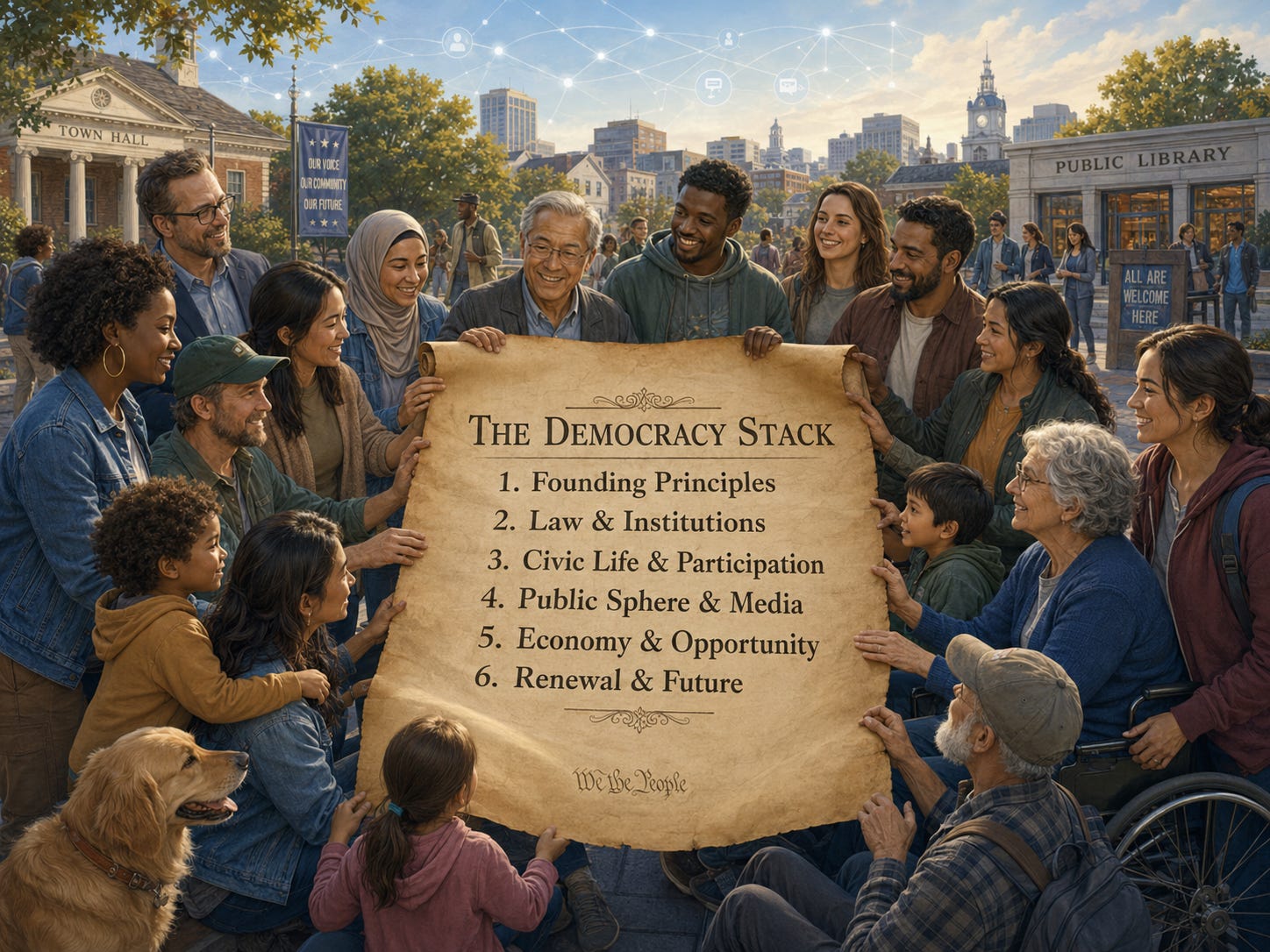
What is the Democracy Stack?
The American experiment is built on a simple yet profound proposition: all people possess inherent dignity, legitimate public power requires the consent of the governed, and citizens hold the ultimate authority to reform and renew their public institutions. However, these principles do not protect themselves.
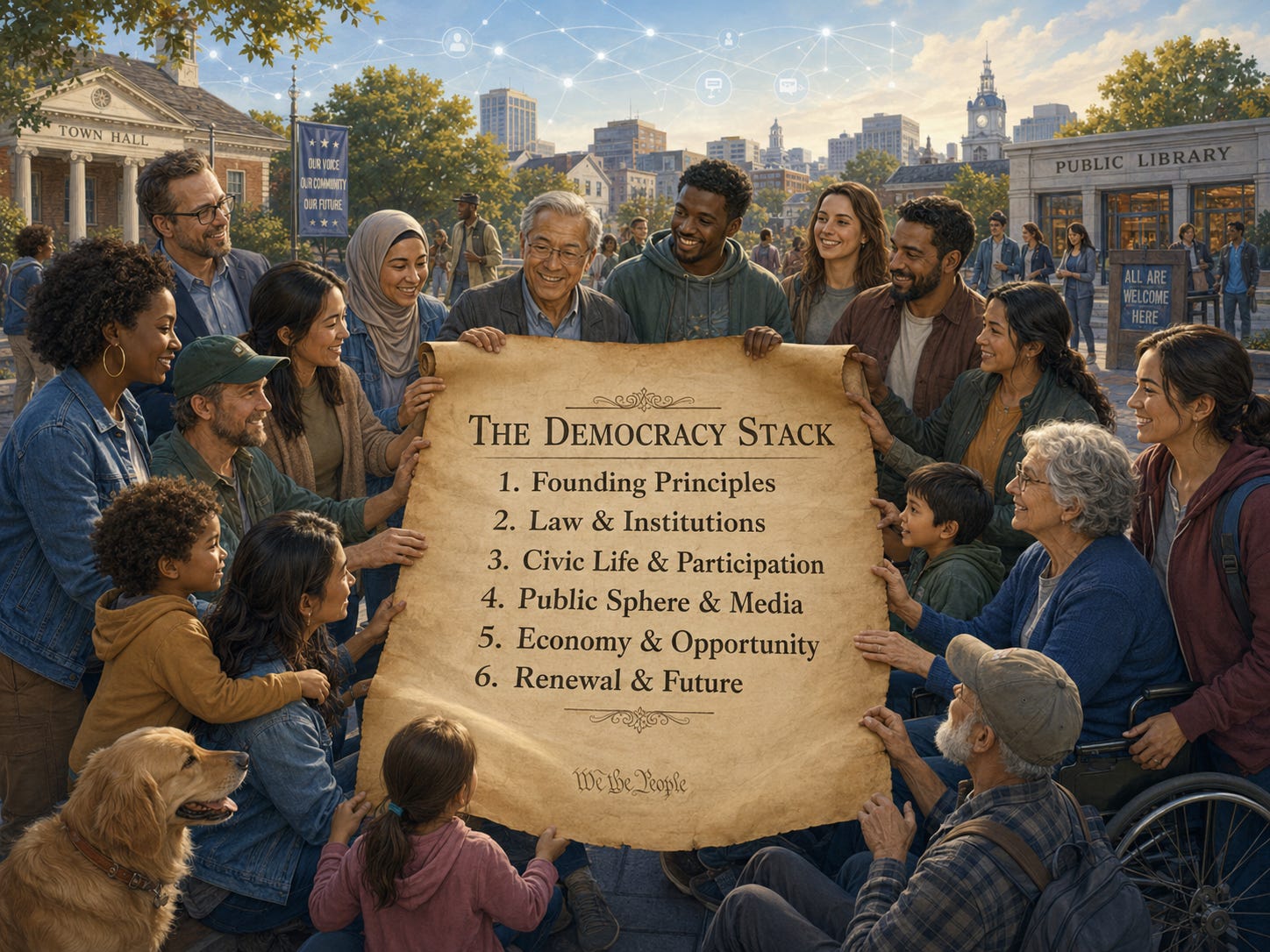
Democracy is not a single mechanism or a one-off event like an election. It is a layered system—a stack. The visible surface of civic life (elections, local ordinances, public meetings) rests entirely upon deeper, often invisible foundational layers. If the lower layers decay—due to an erosion of community trust, economic desperation, or systems that are too complicated to navigate—the upper layers lose their substance.
The Democracy Stack is a framework for republican self-defense. It serves as a structural map to help citizens locate where power lives, ask the right questions, and pick up the correct civic tools to intervene effectively in their communities.
The Montco Context: Mapping Power in Our Communities
In Montgomery County, PA, the Democracy Stack serves as an essential framework for navigating the vast resource disparities between our townships and boroughs. Whether dealing with the rapid growth of AI and technological displacement or trying to access county programs, Montco residents face an increasingly complex legal and administrative environment.
The Stack breaks down local self-government into manageable layers, helping a resident in Pottstown, Norristown, Lansdale, or Lower Merion figure out exactly who holds accountability for a given issue. By using the Citizen Toolbox—which includes Ecosystem Maps, Bureaucratic Tracers, and Action Checklists—ordinary citizens can move past a state of frustration and toward evidence-based civic action. Instead of remaining passive consumers of local politics, citizens can assert their proper role as the active managers of their communities.
The Testing Ground: The First 1,000 Days Initiative
The First 1,000 Days Initiative in Montgomery County serves as our primary real-world laboratory for putting the Democracy Stack into practice. Operating under a salutogenic paradigm—which focuses actively on the factors that create health and human flourishing rather than simply treating disease—the initiative re-centers public policy around the absolute foundation of the Stack: the human being.
The initiative addresses a critical Capital Matching problem right here in Montco. While financial capital programs exist, local families are often eligible for up to $37,400 in developmental and healthcare support stack that they fail to receive. This is not due to a lack of need, but to the systemic friction, administrative opacity, and coordination gaps built into our bureaucratic systems.
To bridge this gap, the initiative focuses on building the human and digital capital necessary for families to successfully “cash the check of the republic.” This includes piloting next-generation tools like the Whole Person Salutogenic Assistant (WPSA)—an intentional deployment of AI designed to enhance, rather than diminish, user independence and epistemic autonomy.
The Dashboard of Accountability: Six Newborns
To ensure the Democracy Stack remains an instrument of practical justice rather than abstract theory, the initiative tracks the equitable distribution of support through the lived experiences of six newborns across Montco zip codes:
Grace (Lower Merion): Born into an area with a median income over $130,000, Grace has immediate, frictionless access to her full developmental support stack.
Jaylen (Norristown): Navigates a $45,000 median income environment and faces steep service coordination gaps that threaten his developmental trajectory.
Sofia (Lansdale): Faces language access barriers to WIC and health benefits alongside familial risks of technological job displacement.
Aiden (Pottstown): Battles geographic isolation from specialized care networks and experiences the highest regional risk of manufacturing automation displacement.
Amara & Riley (Cheltenham/Abington): Exposed to the intersection of higher maternal mortality rates and the economic fragility common to single-parent households.
The Goal: The Democracy Stack succeeds when the tools in the Citizen Toolbox remove systemic friction so completely that all six of these newborns have identical opportunities to thrive, regardless of their starting zip code.
How to Deploy the Citizen Toolbox
The draft section inside the Citizen Tool Box connects the layers of the Democracy Stack directly to practical instruments of civic action:
Ecosystem Maps: Used to orient yourself and find exactly where authority sits. For example, a parent can map out exactly which County Commissioner or State Senator holds control over early intervention funding.
Working Paper: The Democracy Stack OverviewTracers: A clinical diagnostic tool borrowed from healthcare. It allows a citizen to “follow the journey” of a service or funding stream (like a WIC application) step-by-step to identify exactly where the bureaucratic breakdown occurs.
Working Paper: The Democracy Stack OverviewChecklists: Simple, step-by-step engagement guides designed to demystify complex public interactions, ensuring that a brief meeting with a representative or a public comment at a school board meeting results in a tangible commitment.
Working Paper: The Democracy Stack OverviewCitizen Briefs: Actionable, multi-stakeholder roadmaps authored directly by the community members closest to a problem, forcing institutional leadership to address localized gaps in care and safety.
Gemini