

Six fictional newborns are helping Montgomery County ask a very real question: What should every child be able to count on during the first 1,000 days?
A baby does not arrive in the world as a statistic.
She arrives in a family. In a neighborhood. Into relationships already forming around her. Into a healthcare system, a housing market, a workplace, a childcare system, a school district, a local government, and a set of public choices made long before she took her first breath.
Some of those systems will make life easier for her parents.
Others will create friction.
Some will notice the family before there is a crisis.
Others will wait for the family to find the right office, complete the right form, make the right phone call, or learn that help existed at all.
And that is where the Montco PA Moonshot Class of 2026 begins.
Grace. Jaylen. Sofia. Aiden. Amara. Riley.
Six fictional composite newborns. Six Montgomery County communities. Six different ways of looking at the same question:
What would it take for every child born here to have the conditions needed to flourish?
They are all born with equal worth.
They are not born into equal conditions.
Why invent six babies?
Because public policy usually begins at the wrong end of the telescope.
We talk about appropriations, regulations, agencies, eligibility thresholds, reimbursement rates, school funding formulas, nonprofit tax status, program capacity, and administrative burden.
All of those matter.
But families experience public systems differently.
They experience an appointment they cannot make because of work.
A pediatrician who notices something early.
A Head Start seat that is available—or is not.
A translated brochure that still does not answer the family’s question.
A grandmother who can watch the baby.
A four-month childcare wait.
A hospital five minutes away.
A service fifteen minutes away that somehow remains unreachable.
A public benefit the family never learns it qualifies for.
A community institution that has been there for generations.
The Moonshot Class allows us to start with the child and work outward.
The children are not predictions. They are not demographic stereotypes. And they are not real individuals.
They are AI-assisted fictional composites, built from public information, research, community context, and recurring family experiences. Their purpose is to make systems visible without pretending that a ZIP code determines a child’s future.
They are civic case studies.
Meet the Class
Each newborn gives us a different diagnostic lens.
Grace — Lower Merion
The Floor
Grace begins life with many supports already aligned: healthcare, transportation, parental flexibility, information, financial security, and people who know how to navigate institutions.
Her question is:
Which of the conditions surrounding Grace should remain private advantages—and which should become the floor beneath every child?
Grace shows us what becomes possible when friction is reduced.
Jaylen — Norristown
The Distribution Question
Jaylen grows up near extraordinary resources: a strong regional hospital, transit, county government, community institutions, and some of the wealthiest neighborhoods in Pennsylvania.
His question is:
Why does proximity to opportunity not necessarily mean access to it?
Jaylen asks us to look not only at where resources exist, but at where their benefits actually land.
Sofia — Lansdale
The Visibility Question
Sofia lives in a community that can look prosperous when viewed through town-wide averages.
Look closer, and the picture becomes more complicated.
Her question is:
Who disappears when public institutions judge a community by its average?
Sofia asks whether programs can see families across differences in income, language, work schedules, culture, and trust—and whether cultural strengths such as bilingualism are recognized rather than treated primarily as deficits.
Aiden — Pottstown
The Accountability Question
Aiden lives in a community with real assets, real institutions, real public investment—and significant economic pressure.
His story asks what happens when institutions that occupy an important place in community life do not fully strengthen the ecosystem around them.
His question is:
What do major institutions owe the children and communities whose public trust, resources, and support help sustain them?
Aiden turns “community benefit” from an accounting term into a civic question.
Amara — La Mott, Cheltenham
The Renewal Question
Amara inherits something unusual: a neighborhood whose history is deeply connected to abolition, Black military service, integration, and a deliberate commitment to dignity.
Her question is:
What does a community built on a promise of dignity owe the generation born there today?
Amara asks whether history remains a living obligation—or becomes only something we commemorate.
Riley — Abington
The Standard
Riley lives near Montgomery County’s broad middle.
No dramatic deprivation. No extraordinary benchmark.
That is precisely Riley’s role.
Riley asks:
If this is what “average” looks like in Montgomery County, is average good enough?
Riley turns the six individual stories back toward the county as a whole.
Together, the six newborns become something more than characters.
They become a civic diagnostic instrument.
The First Test: Head Start
We are putting that instrument to work immediately.
The first major public deliberation involving the Moonshot Class will focus on Head Start and Early Head Start.
That is not accidental.
For more than half a century, Head Start has embodied an important insight: children cannot be neatly separated into education, health, nutrition, family life, and community.
A young child develops across all of them at once.
Head Start therefore gives us a concrete public program through which to ask much larger questions:
What should families be able to count on?
Which supports should be universal?
Which should increase according to need?
How much should be national, and how much should communities design locally?
How do we preserve accountability while allowing flexibility?
How do we know whether a program that exists is actually reaching families?
And perhaps most importantly:
What has Head Start taught America about what it takes to give a child a genuine head start—and what should come next?
Each newborn tests that question differently.
Grace asks whether the comprehensive supports some families assemble privately should inform a broader civic floor.
Jaylen asks whether a program is meaningful if it exists nearby but families cannot reliably reach it.
Sofia asks whether formally equal access is enough when language, trust, schedules, and administrative complexity shape who participates.
Aiden asks how Head Start fits into a wider ecosystem of hospitals, schools, employers, local government, and community institutions.
Amara asks whether family voice, cultural identity, belonging, and community history should be understood as developmental assets.
Riley asks the ultimate design question:
What standard are we trying to build for every child?
The Moonshot children will not determine the answer.
They will help us test our answers.
Understand. Deliberate. Act. Follow Up.
The Montco PA Moonshot Class is part of Thrive in Montco PA’s larger civic method.
Understand
We begin with evidence.
Each child has a living Wix case file exploring the family and community ecosystem, the First 1,000 Days journey, strengths, pressures, public institutions, relevant policy questions, and sources.
Each also has a downloadable Citizen Brief and Action Guide.
The goal is not to tell readers what to think.
It is to make the system understandable enough that citizens can think about it seriously.
Deliberate
The People’s Commission will use the newborns as cases for structured public inquiry.
The Head Start deliberation will examine evidence, competing principles, implementation realities, community experience, and unanswered questions.
We will ask not merely whether a proposed change sounds good, but:
What would it mean for Grace? Jaylen? Sofia? Aiden? Amara? Riley?
Who benefits?
Who might still be missed?
What tradeoffs are real?
What evidence do we still need?
Act
Understanding without agency is not enough.
Citizen Briefs and the Citizen Toolbox will help residents:
contribute local experience,
identify missing evidence,
examine community resources,
ask better questions of public officials,
participate in public rulemaking,
attend deliberations,
contact institutions,
and propose practical improvements.
Follow Up
And then we will do something civic projects too often neglect.
We will follow what happens next.
Did an agency respond?
Did a program change?
Did a legislator answer?
Did new evidence alter our view?
Did the community identify a better solution?
Each child’s living case file will maintain a record of developments, corrections, unanswered questions, and public responses.
That is how a story becomes civic infrastructure.
A National Question, Tested Locally
Montgomery County is not America.
But it is a remarkably useful laboratory.
Within one county we can see wealth and poverty, urban density and suburban affluence, historic communities and rapidly changing ones, immigrants and multigenerational families, nationally recognized hospitals and uneven access, strong schools and strained systems.
That makes Montco a place where an American question can become local and concrete:
What do we owe the next generation?
Not in theory.
Not someday.
To the babies being born now.
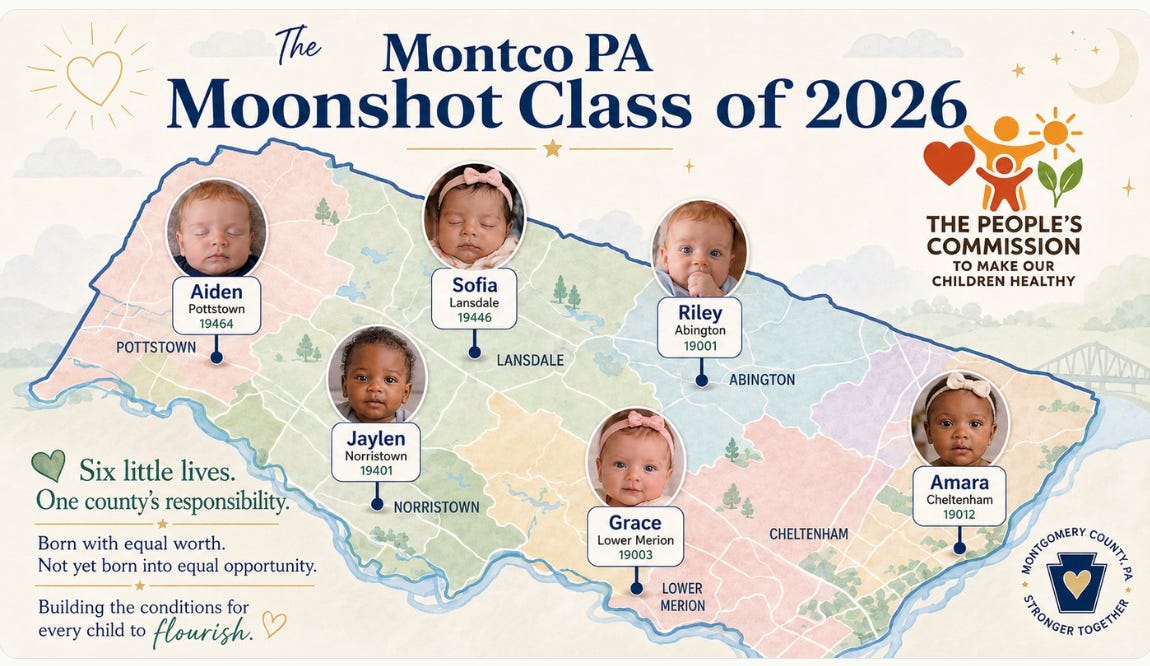
Grace, Jaylen, Sofia, Aiden, Amara, and Riley will grow through their first 1,000 days while we ask that question.
They cannot vote.
They cannot attend a county meeting.
They cannot submit a public comment.
They cannot ask whether the systems surrounding them make sense.
We can.
And that is the experiment.
Six little lives. One county’s responsibility.
Born with equal worth. Not yet born into equal opportunity.
Building the conditions for every child to flourish.
[Meet the Montco PA Moonshot Class of 2026]
[Enter the Head Start Citizen Deliberation]
[Explore the First 1,000 Days Initiative]
[Join the People’s Commission]
[Subscribe and Follow the Journey]
Editorial note: The Moonshot Class children are fictional composites. This project is human-led and developed with artificial intelligence as a tool for research, synthesis, scenario development, and drafting. Public facts and composite narrative elements are labeled separately in the underlying case files and Citizen Briefs. Editorial responsibility, verification, corrections, and publication decisions remain human. Local knowledge, better evidence, and corrections are welcomed.