

Brief Introduction
The Montco Head Start Citizen Deliberation is the first public project of the broader First 1,000 Days in Montco PA Initiative. It uses Head Start as a practical starting point for exploring how Montgomery County can help every child build strong foundations for health, learning, relationships, and lifelong flourishing.
Head Start currently provides eligible Montgomery County children ages three to five with free early education and health, nutrition, social, and family services. Early Head Start extends this comprehensive approach to pregnancy, infancy, and toddlerhood—the period most directly connected to the First 1,000 Days.
Through the deliberation, residents, parents, educators, service providers, and community leaders can learn how these programs work, consider proposed federal changes, share local experience, and contribute informed public comments. The work will then continue beyond the immediate rulemaking to address a larger Montco question: What would it take to give every child—not only those currently eligible for Head Start—the conditions needed for a healthy and flourishing beginning?
Join the Montco Head Start Citizen Deliberation
The Montco PA, Head Start Citizen Deliberation
What does a federal Head Start regulation have to do with a child growing up in Norristown, Pottstown, Lansdale, Abington, Cheltenham or Lower Merion?
That is the question behind the Montgomery County Head Start Citizen Deliberation.
The federal government has proposed major changes to the rules governing Head Start. The public has until October 6, 2026, to submit comments before the government decides whether and how to finalize those changes.
The national debate involves federal laws, regulations and billions of dollars. But every Head Start rule eventually becomes local. It affects an actual classroom, home visitor, family, teacher, health referral and child.
Montgomery County gives us a place to follow that journey.
Through Thrive in Montco PA, Moonshot Press is inviting parents, educators, Head Start professionals, healthcare providers, researchers, public officials, community organizations and residents to examine what the proposed changes could mean here—and to ask what our county can teach the country about supporting children during the First 1,000 Days of life.
The immediate purpose is to help Montgomery County residents participate in the federal rulemaking.
The longer purpose is more ambitious:
How can Montgomery County create the conditions that give every child a genuine opportunity to flourish from pregnancy through age two?
One Federal Decision, One Local Community
Head Start is a national program delivered through local organizations.
Created in 1965, Head Start combines early education with health, nutrition, developmental screening, family engagement and connections to community services. Nationally, it has served more than 40 million children and families.
In Montgomery County, the Montgomery County Intermediate Unit provides Head Start Preschool services for eligible children ages three to five. The program offers educational, nutritional and social services intended to help children prepare for school.
Early Head Start reaches further back toward the beginning of life. The Montgomery County Intermediate Unit describes its partnership with the Maternity Care Coalition, which has offered home-based and center-based Early Head Start services to pregnant women and families with children from birth to age three in the Norristown, Pottstown and Lansdale areas.
These programs operate within a much larger local system that includes:
Families and caregivers
Childcare providers
Pediatric and maternity-care practices
Hospitals and community health centers
Early-intervention services
WIC and nutrition programs
School districts and the Montgomery County Intermediate Unit
The county Office of Public Health and other human-service agencies
Pennsylvania’s Early Learning Resource Center and Child Care Works
Libraries, faith communities and neighborhood organizations
Employers, transportation systems and housing providers
No single program controls all the conditions affecting a child.
That is why the Montco deliberation will not examine Head Start in isolation. It will ask how Head Start fits into the wider system surrounding children and families—and where that system is strong, fragmented, difficult to reach or incomplete.

Why Montgomery County?
Montgomery County is sometimes described through countywide averages: strong schools, major healthcare institutions, high household incomes and substantial community resources.
But averages can hide important differences.
The experience of a family in Lower Merion may differ significantly from that of a family in Norristown, Pottstown or another part of the county. Transportation, housing costs, language, work schedules, childcare availability, trust in institutions and proximity to healthcare can all affect whether a family can use the resources that technically exist.
Montgomery County’s first Community Health Assessment was released in 2025 to describe health and well-being across the county and help inform future community-health planning.
The Head Start Citizen Deliberation builds on that local-learning approach.
It asks residents to look beyond whether a program appears on a map and consider five different questions:
Does the program or service exist?
Is the child or family eligible?
Is there enough capacity to serve them?
Can the family realistically reach, trust and use the service?
Does the service provide the quality and support the family needs?
A public promise is not complete until it can be experienced by the people it is meant to serve.
The Immediate Question: What Should Happen to the Head Start Rules?
The federal government has proposed rescinding and replacing the current Head Start Program Performance Standards. The Department of Health and Human Services argues that the changes would reduce administrative burden, return greater control to local programs and states, and allow resources to be used to serve more children.
Others are concerned that removing detailed federal standards could weaken protections involving health, safety, staffing, family engagement, program quality and accountability.
The Montco deliberation will not begin by telling residents which side to join.
Instead, it will ask:
Which federal standards are essential to protecting children and families?
Which requirements create work without producing enough public benefit?
Where could local flexibility help Montgomery County programs respond more effectively?
Where could replacing federal standards with state requirements reduce quality or consistency?
How would changes affect teachers, home visitors, administrators and community partners?
Would projected savings actually expand access?
What practical alternatives could reduce burden while preserving important protections?
These questions should be informed by people who understand how programs operate—not only by national organizations and government officials.
Parents can explain whether services are accessible and respectful. Teachers and home visitors can describe which requirements support their work and which interfere with it. Program leaders can identify workforce, funding and administrative realities. Health professionals can explain the importance of screening, referrals and care coordination. Community organizations can identify gaps that are difficult to see from Washington.
Local experience can become part of the federal public record.
The Longer Question: What Should Every Montco Child Be Able to Count On?
The October 6 deadline is the end of the public-comment period. It is not the end of the Montgomery County initiative.
After the comment period, Moonshot Press and Thrive in Montco PA will review the public record, follow the federal government’s response and use what we learn to advance the Montco PA First 1,000 Days Initiative.
The First 1,000 Days generally refer to the period from pregnancy through a child’s second birthday. During this time, foundations are being established for physical health, emotional security, language, learning, relationships and the ability to manage stress.
The Montco initiative asks:
What should every child and family in Montgomery County be able to count on during this period?
That question is broader than Head Start.
It includes prenatal and postpartum care, parental health, nutrition, safe housing, developmental screening, childcare, early intervention, caregiver support, paid leave, transportation, trusted information and strong community relationships.
It also requires us to distinguish between Head Start, the existing federal program, and a head start for every child, the larger aspiration.
The longer inquiry will not assume that the current Head Start program should simply be extended unchanged to every newborn. Instead, it will examine:
Which parts of Head Start should be protected or expanded
What Early Head Start can teach us about pregnancy, infancy and family support
Which families are currently reached and which remain outside the system
How Head Start connects with healthcare, WIC, childcare and early intervention
What should be available to every family
What additional support should be based on need
Which responsibilities belong to the county, Pennsylvania and the federal government
What employers, healthcare systems and community institutions should contribute
How progress toward flourishing should be measured
Head Start is therefore a national program, a local service and a valuable learning case for a larger community mission.
A Salutogenic Approach: Creating Health, Not Only Preventing Harm
The Montco First 1,000 Days Initiative is grounded in a salutogenic framework.
Salutogenesis means creating and sustaining health. It asks not only what causes illness or hardship, but what helps people and communities develop the capacity to thrive.
Preventing disease remains important. So do safety, treatment and protection from harm. But a child needs more than the absence of illness. A family needs more than assistance during a crisis. A community needs more than programs that respond only after problems become severe.
A salutogenic approach asks whether families experience three important conditions:
Comprehensibility: Can families understand their child’s development and the services available to them?
Manageability: Do they have the resources, relationships and practical support needed to meet challenges?
Meaningfulness: Are they respected as active partners, connected to their communities and confident that their efforts matter?
Applied locally, the salutogenic standard asks:
Does Montgomery County’s system merely manage problems, or does it help create the conditions for children, caregivers and communities to flourish?
This changes how we evaluate success.
We should still examine enrollment, compliance and school readiness. But we should also ask whether caregivers feel supported, whether referrals lead to usable services, whether systems work together and whether children begin life surrounded by conditions that strengthen health, agency, adaptability and belonging.
Meet the Montco Moonshot Class of 2026
Public policy can quickly become abstract. The Montco PA Moonshot Class of 2026 brings the inquiry back to the children whose lives will be shaped by the decisions adults make.
Grace, Jaylen, Sofia, Aiden, Amara and Riley are six fictional composite children connected to different Montgomery County communities. They are not real individuals, and their stories are not predictions.
Each child offers a different lens:
What does opportunity look like when many supports are already present?
What happens when work, transportation, childcare and public programs do not fit together?
How do language, culture and trust affect access?
How does geography shape the services a family can use?
How do historic and structural conditions affect health and opportunity?
What happens when abundant resources remain fragmented and difficult to coordinate?
The children’s stories do not provide evidence about a particular family or prove that a policy is right or wrong.
They help us ask better questions.
Together, they form a civic casebook through which residents can examine whether Head Start and the wider First 1,000 Days system work under different local conditions.
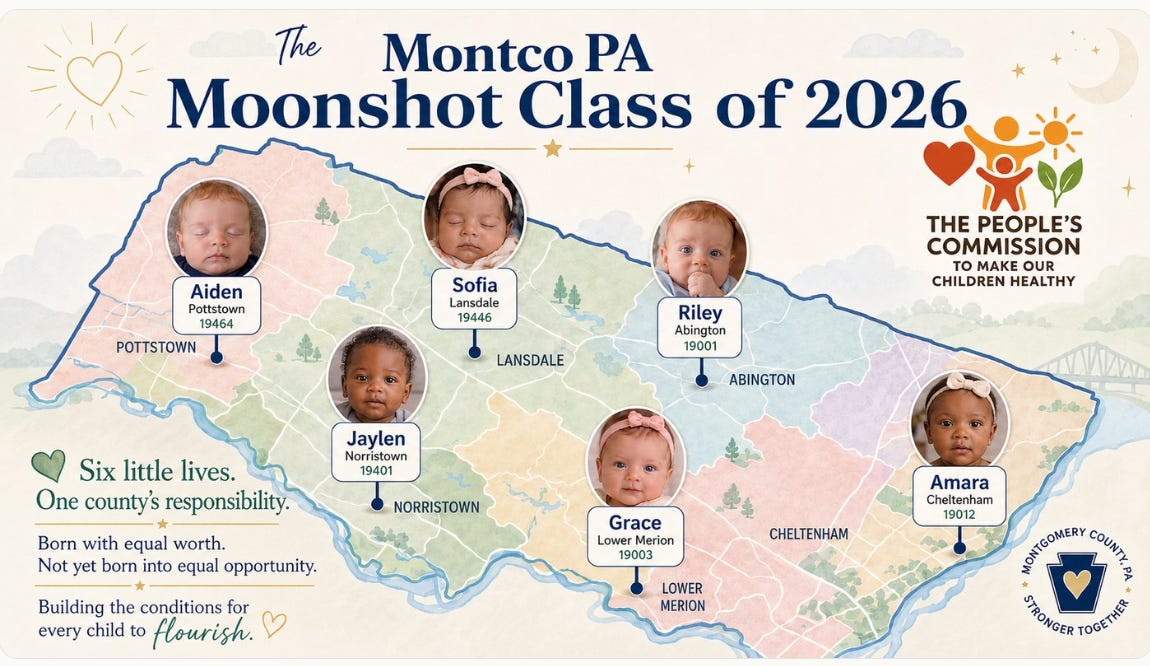
Meet the Montco PA Moonshot Class of 2026 →
A Local Experiment in Civic Journalism
Thrive in Montco PA and Moonshot Press are testing a form of journalism that does more than report what happened after a decision was made.
The project follows four stages.
Understand
Learn how Head Start operates nationally and locally. Examine the proposed rule, local services, available evidence and gaps in what we know.
Deliberate
Listen to families, educators, providers, health professionals, researchers, public officials and residents. Consider the strongest arguments for different approaches.
Act
Contribute a local experience, question, source or correction. Participate in a public conversation. Prepare and submit an original federal comment before October 6.
Review
After the deadline, examine the public record and the government’s eventual decision. Identify what changed, what remained unresolved and what Montgomery County should do next.
This is not a campaign for a predetermined federal or local policy.
It is an effort to help citizens learn together, make disagreements more constructive and connect public participation with accountable action.
Using AI to Make the Public Record Understandable
Moonshot Press plans to use artificial intelligence to help analyze the publicly available comments submitted on the proposed Head Start rule.
Weekly AI-assisted reviews will help readers identify:
The provisions receiving the most attention
The perspectives commenters identify
The leading arguments supporting or opposing different changes
Local experiences and implementation concerns
Proposed alternatives
Important perspectives that may be missing
After the comment period closes, Moonshot Press plans to publish a more comprehensive review of the public record and later compare it with the government’s explanation of the final rule.
AI can help organize thousands of comments, but it cannot decide which arguments are correct or what Montgomery County should do.
Human editors will review the findings, describe the methods used, identify uncertainty and correct errors openly.
The rule remains:
AI recommends. Humans decide. Always.
What Montgomery County Can Contribute
Montgomery County cannot decide the federal rule by itself.
It can contribute something valuable: a detailed account of how a national program operates within a real community.
The local project can examine:
Which organizations provide Head Start and Early Head Start services
Where services are located
Who is eligible
How many funded places are available
Where staffing or capacity limits access
How federal standards compare with Pennsylvania requirements
How programs connect with health and family-support systems
What families and professionals believe should change
Which community strengths could support a more comprehensive approach
This work can help inform federal comments now. It can also create a local baseline for the longer First 1,000 Days Initiative.
The purpose is not to present Montgomery County as a model that already has all the answers. It is to make the county a place where public systems can be understood, community knowledge can be heard and better approaches can be designed together.
Join the Montco Head Start Citizen Deliberation
The federal public-comment period ends October 6, but the local work will continue.
Parents, caregivers, Head Start families, educators, health professionals, program staff, researchers, employers, community organizations, public officials and residents all hold part of the picture.
You can participate by:
Learning how Head Start operates in Montgomery County
Reading the proposed-rule Citizen Brief
Sharing a local experience
Contributing evidence or correcting a factual claim
Joining a listening session or deliberation
Examining one part of the proposed rule
Submitting an original public comment
Helping define what every Montco child should be able to count on
Returning after the federal decision to help shape the next phase
Children cannot submit public comments. They cannot ask why a program lacks space, why a referral leads to a waiting list or why services available in one part of the county are difficult to reach from another.
Citizens can.
That is where the Montco Head Start Citizen Deliberation begins.
Understand the national decision. Examine the local system. Deliberate with neighbors. Act while the decision is open. Then use what we learn to help every Montgomery County child flourish.
Enter the Montgomery County Head Start Citizen Deliberation →
Thrive in Montco PA is a local civic-health initiative developed by Moonshot Press and the Institute for Salutogenesis. The Montco Moonshot Class of 2026 consists of fictional composite children created to support public learning. This project is human-led and uses artificial intelligence for research, comparison, organization and drafting. Human editors remain responsible for evidence, framing, judgments and corrections.